
Shipping Teero from zero to $50M run-rate in 3 years.
Teero is the AI-native platform automating the back-office of US dental practices — a labor marketplace placing hygienists into open shifts, and an accounts-receivable suite where AI agents handle claims and billing.
When I joined as founding designer in 2023, the founders had just committed to a dental pivot from an ATS. No product yet. No brand. No story. Just a spreadsheet and a trade-show deadline in Minnesota.
4.9
Trustpilot rating
5x
Revenue growth
in 2025
#1
Largest US employer
of 3,500+ dental hygienists
$50M
The marketplace
Dental staffing ran on fixed rates and blind bookings. Every competitor showed a shift's hours, pay, and driving distance — but never which office. Meanwhile the ops layer of Teero was matching hygienists to offices from a Google Sheet, calling every office to confirm every shift.
Month one — the Pro app
I designed the Pro App for hygienists to fix what every competitor was getting wrong. Where other platforms showed just hours, pay, and driving distance, the Pro App showed the whole picture — practice name, photos of the space, hygienist reviews, address, and every day priced on its own. Office expectations came up front too: the software a hygienist would use, the procedures she'd handle, the patient type, whether nitrous oxide was in play. Two-way clarity — she knew what she'd be walking into, and the office knew she'd seen it. And instead of applying day by day, hygienists could book a whole week in one click. Booking a shift stopped feeling like a lottery.
The three engineers on the team weren't full-time on Teero — they were also keeping the ATS business alive. So I designed while they built between fires. Once the app launched, I watched livesession.io recordings daily. Where hygienists stalled, we redesigned. Where they took shortcuts, we removed steps.


Month two — the Office app
The Office app for dental offices followed right after the Pro app launch — the piece that got Teero off the phone. Offices could add and remove open shifts themselves, see who was coming which day, and manage their own bookings without calling us.
The design move that got the business flowing fast: we gave the office one option, not a list.
Competitors gave office managers a whole roster to choose from. In practice OMs waited for the "right" candidate they'd never find, wasting the day while the shift sat open. We handed them a single option — vetted, ready — and moved on.
Underneath, an ordering rule picked who that one option was: favourite hygienist → first responder → partial-shift requester (always last, even if favourite). No scroll-through beauty contest. No skills or skin-colour bias. Teero vetted; the office trusted the order.
By the end of month two, the numbers on dental were strong enough to shut the ATS down. All three engineers were full-time on dental.


The rebrand
The initial visuals came from the ATS era. Layered on top: hit-and-run product slides thrown together under pressure, surfaces that had never been designed together. The dental pivot was living on teero-dental.com, with a dash dragging the search for us. It was a mess.
Dental staffing had an audience problem too. Our users were hygienists and office managers — mostly women, mostly 40+, in an industry that had never caught up with the rest of healthcare's move to tech. Patient data still lived on personal servers in the back rooms of practices. Every SaaS competitor arrived the same way — bright colours, startup energy, zero credibility. Users had been burned enough times to not trust another one.
We needed a real brand to stand out — and to be trusted. Software is invisible; buyers judge it by the website, the UI, the brand look. A defined brand turns a generic SaaS into a memorable, trusted choice — not one more commodity in a race to the cheapest price.
Initially the founders weren't ready. I made the case for the long-term value — a bigger Teero would only be more expensive to rebrand later. They agreed. Ten weeks later it was live.


The voice & its impact
The voice guide was our golden artifact. Not for how it read on the page, but for what came after — every AI-powered thing we'd build next ran on top of it. The voice guide is a set of traits that writers (and AI) weight per message. The exact percentages don't matter — what matters is which trait leads and roughly how far apart the others are.
AI, now at brand-voice speed — Once the dial existed, we fed it straight into AI. Product copy, marketing copy, hygienist messages — iterating, learning. The team shipped on-brand copy in minutes instead of days.
Personalised automated messages — A year on, AI was writing check-ins at scale — a note after a hygienist had a baby, a follow-up weeks after an injury, a well-done after a great shift. Automated by default, with human review for anything flagged. Hygienists and Office managers didn't know the messages were AI. They just knew someone at Teero remembered.

Pro app improvements that followed
Dynamic Type — Support messages piled up — hygienists had trouble booking shifts and clocking out. The livesession recordings showed me why: buttons scrolling off-screen, forms that refused to submit. The culprit was Dynamic Type — the iOS accessibility setting that scales up every piece of text, the kind of thing you've probably watched a (grand) parent lean into. I'd never thought about it. Then the data landed: ~40% of our hygienists had it turned up. At 2× the app broke. I capped Dynamic Type at 1.35× inside the app, and from that point every screen had two versions. A trade competitors never made.

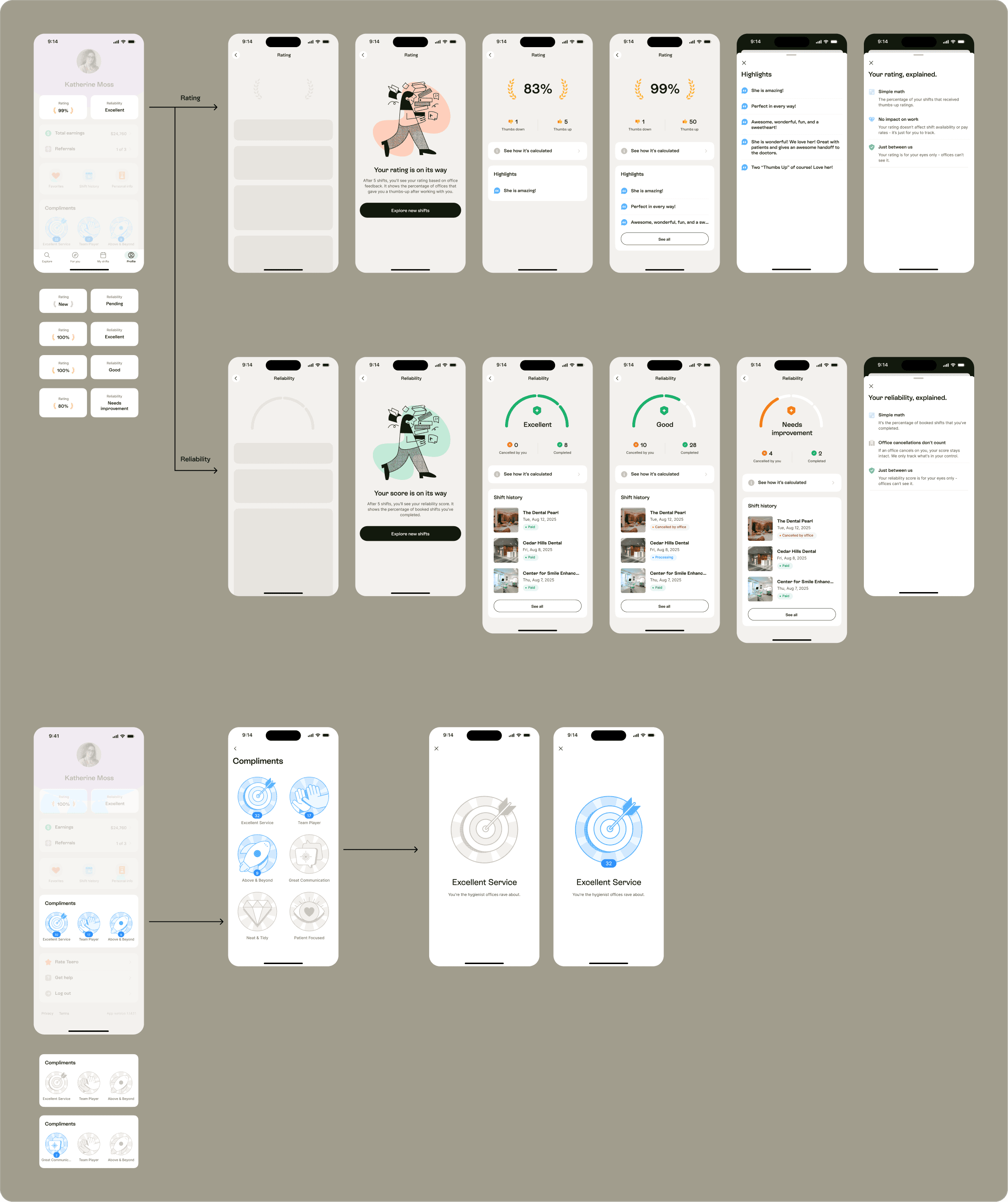
Profile as a retention bet — When interviewing hygienists and listening back to onboarding calls, I learned that hygienists weren't afraid of trying another platform. They were afraid of losing what they'd built on their current one. Reliability percent. Years of shift history. US workers love a scoreboard — so we leaned in. Every milestone, every stat, every data point that made a hygienist open her profile and think "I've built this" went into the app.
Even as we grew to 3,500+ active hygienists, monthly churn held ~10%.
The W-2 transition
Teero started with hygienists as 1099 contractors — the setup that seemed right at the time. Then we learned in half of US states, 1099 as a dental hygienist is illegal. Consulted with lawyers. Switched. We were hesitant — for worst cases that never materialised, and for the product changes it required. But it was the right move: hygienists had been asking for it, DSOs wouldn't consider us without it.
Pro app impact
The product work was substantial — a contract-signing flow for every hygienist, a payroll stack built into the Pro app (payslips, tax forms, benefits), and vendor APIs on the back end. Teero became the employer; the Pro app had to feel like one.

Office impact — Smart Pricing
W-2 fees changed shift economics. The founders' instinct was to switch to the competitor model — offices set their own hourly rate. I pushed back hard. Teero's match rate was 65% to the industry's 35%. Switching to their lesser model made no sense. Offices are not built to judge fair-market fees — they think about "the extra we now pay," not "the extra revenue a filled shift brings in."
The alternative I introduced — and named — was Smart Pricing. Offices set a range; Teero matched at the best price both sides accepted. The model knew what no office could — that a Minneapolis office booking a Monday six weeks out would fill at one rate, and the same office booking a Friday last-minute would need another. Dozens of variables underneath: location, day-of-week, lead time, local supply, office rating, time of year. Data-driven, not office-guessed.

Scaling the business
The marketplace worked. The brand worked. What came next was finding the capital — and the operational mechanics — to make them work in 50 states instead of 9.
Getting noticed
In 2024, Heartland — the biggest DSO in the country — wanted in on the marketplace. They offered us a white-label deal. We turned it down. The strategy was SMB dental offices; white-labelling would have blurred it.
The point isn't the deal we passed on. The point is that Heartland runs over 1,900 locations across 39 states, and we were on their radar. When the biggest dog in your category comes to your door with an offer, you're on the right track — whether you take the deal or not.
Through the same year we ran the Series A loop. The founders led. I pushed back on positioning and rewrote deck slides after every investor conversation — fifty+ rewrites. By the last meetings, almost no investor question was left standing. We'd covered every topic so well there was nothing left to poke at.
Round closed late 2024.


Luna — the AI onboarding agent
By May 2025 the team was hitting 1,000 hygienist onboarding calls a month. The founders were personally taking calls on weekend nights. That wasn't growth — that was a scaling wall.
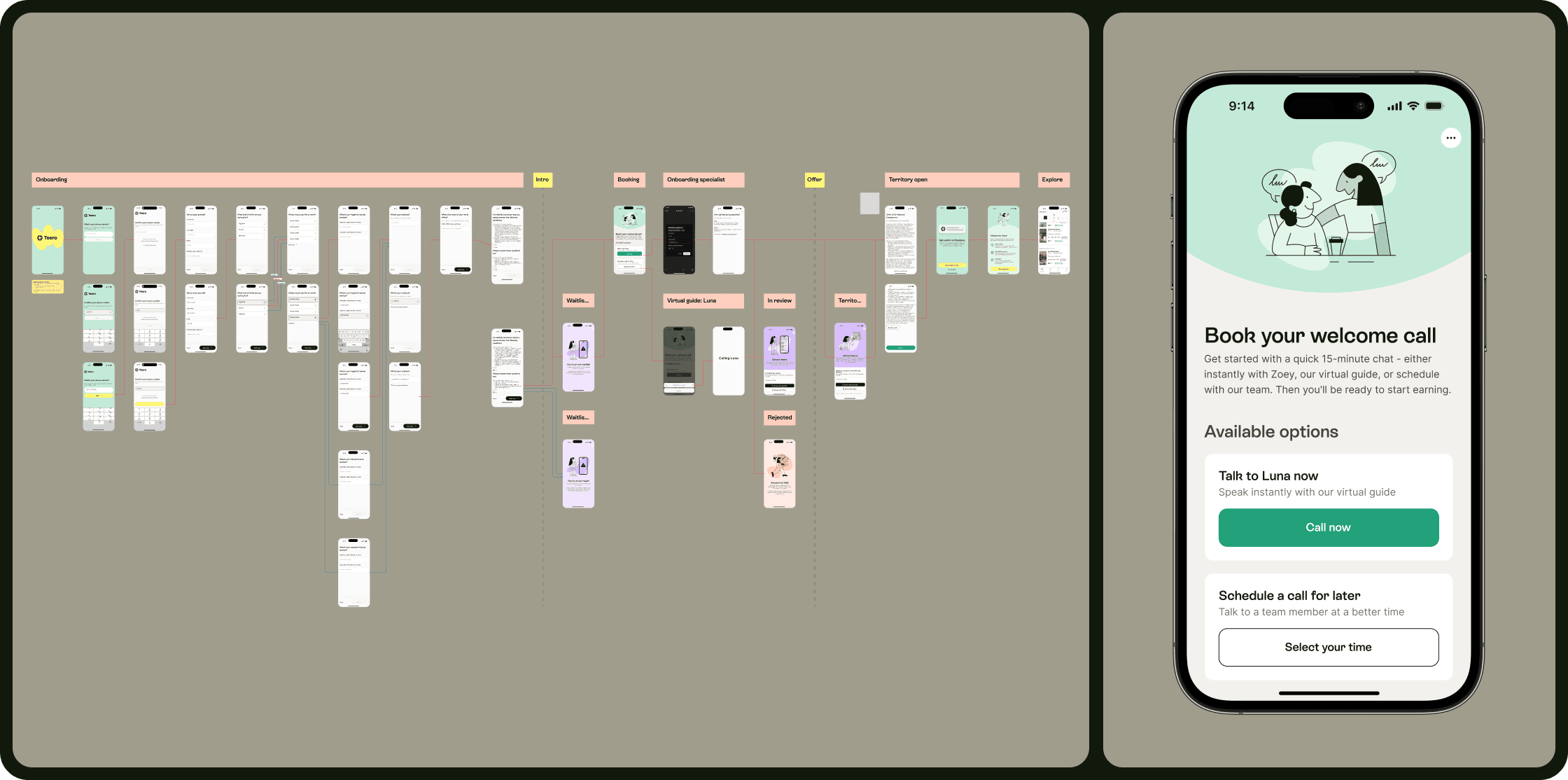
So we built Luna — a voice AI onboarding agent trained on years of onboarding call transcripts and the voice guide from the rebrand. Hygienists chose AI or human at signup.
My design work was voice-training and everything beyond: multiple flows for the different kinds of caller Luna would meet, a choice screen that gave hygienists Luna or a human, and the edge cases — dropped calls, misfires, competitor spies flagged for review, a checklist backstop for anything Luna wasn't fully confident in.
Over 60% of new hygienists chose Luna. Better first-shift conversion than the humans she replaced. The weekend-vetter bottleneck disappeared. 9 states at the start of 2025. All 50 states were live by October.
Staffing got us through the door.
Staffing was always the wedge. Once we were top of the market, we'd earned the right to sell dental offices their next product. We mapped the office's whole back-office pain stack — payroll, scheduling, patient flow, supplies, insurance, billing — against two filters: where does Teero have the deepest wedge? and what's the biggest number we can move? RCM — Revenue Cycle Management — won on both.


RCM: automation attempt, service pivot
Dental offices live and die by insurance billing. Submit a claim, wait weeks or months for payment — if the money ever comes. Chance of collecting after a patient leaves drops to near zero at two weeks. Every office is quietly leaking revenue they're owed. RCM is the function that stops the leak.
The problem underneath: data. Two thousand procedure codes. Thousands of insurance carriers. Each with different rules — which codes bill with which, which can be used only once a year, which vary carrier-by-carrier. No central library. One insurance has an API. A few expose partial data. Most still require hour-long phone calls or faxes. Insurance companies have zero incentive to open their data; it doesn't make them money.
We started with 3 design partners, competitor research, idea videos across sales and ops before building. First lesson: every piece of truth about a claim lives inside the office's Practice Management System (Dentrix, Eaglesoft, Open Dental). We built a connector to pull it out safely.
The harder lesson — and the strategic one: automation wasn't the real goal. Data was. We couldn't automate what we couldn't access, so we leaned into the manual: Teero staff running claims by hand, call by call, fax by fax. Dental data lives on local office servers; even big tech doesn't own it at scale. Every claim became a point in a dataset no one else had.
Three surfaces shipped from design-partner MVPs to broader release: Insurance Verification, Payment Posting, Claim Submission.


Marketing kept pace
As the product line grew, so did the marketing: a landing page for every surface, pre-launch sign-up forms where products weren't live yet, and a brand refresh across everything. For two years we'd kept illustration because commissioned dental photography was too expensive and stock barely existed. AI changed the maths — and the brand finally got the faces it had been reaching for.
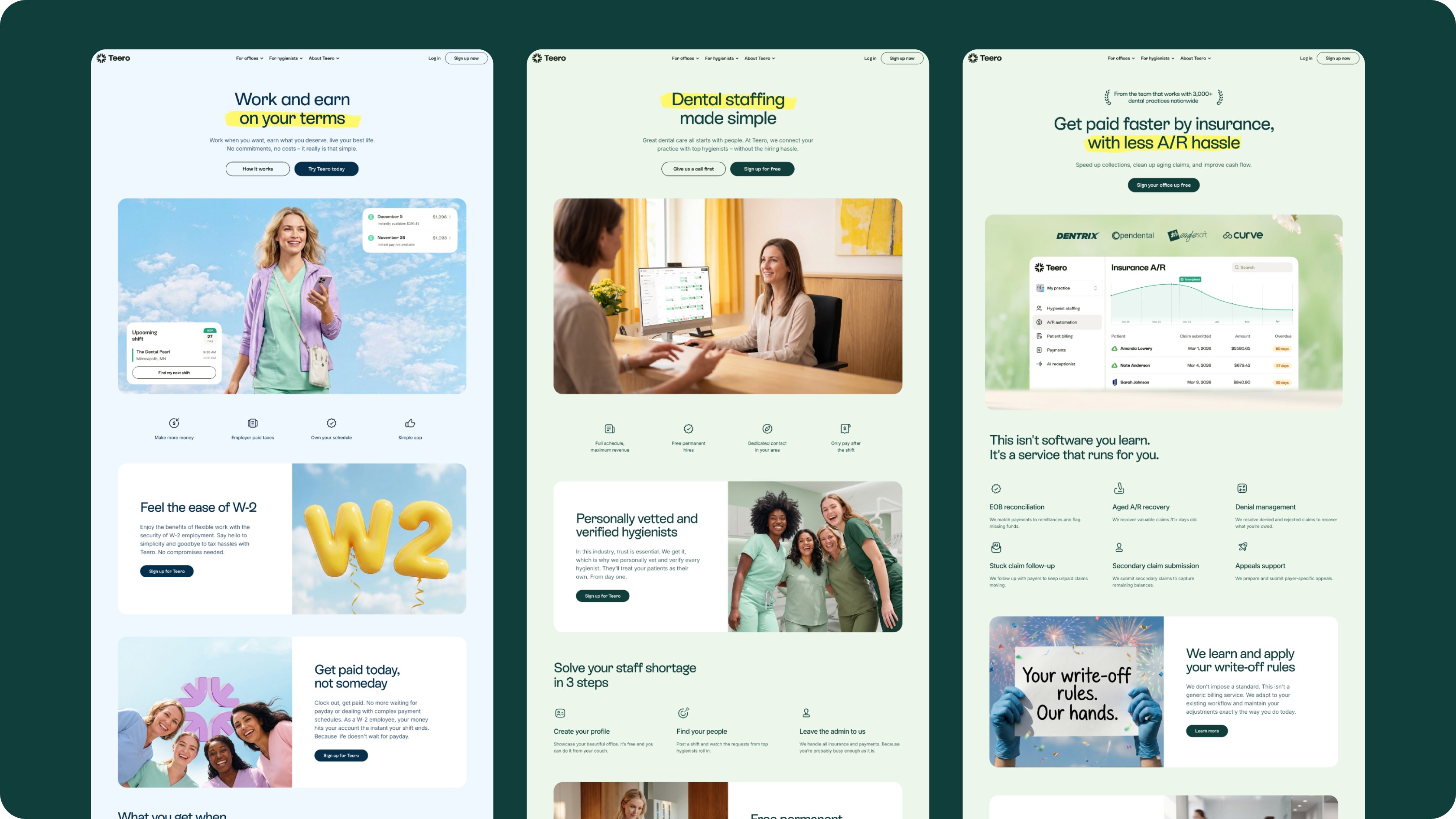

Three years. From an ATS the founders shut down to focus on dental, to an AI-native platform automating the back office for dental practices across all 50 US states. The marketplace found its wedge and built a category around it. The brand became the substrate that let AI scale personal touch across a national workforce. RCM turned staffing customers into billing customers.
4.9
Trustpilot rating
5x
Revenue growth
in 2025
#1
Largest US employer
of 3,500+ dental hygienists
$50M
When we first hired Frank, we were still working on a previous idea before pivoting to Dental. Frank has played a monumental role throughout all of the twist and turns we've had at Teero and helped us get to where we are today.

Nate Anderson
CEO & Co-Founder
Previous
Next case