
Rebuilding Dan.com's
platform and brand
Dan.com is the challenger platform for domain name transfers — on a mission to make trading fast, secure, and transparent in a category that's none of those things by default.
When I joined as Head of Brand and Design four months after their Series A, the tech was strong with blockchain automating domain escrow and a customer team the community trusted. The layer users actually met wasn't. A platform worse than a Google Sheet. A stopgap brand. No design function.
Two rebuilds, in parallel.
4.7
Trustpilot rating
(up from 4.5)
4.7x
Domains growth
(1.7M → 8M+)
2x
Annual GMV increase
(€20M → $43M)
$71.4M
The rebrand — for buyers
Every landing on Dan.com was a first date — 69% of buyers didn't trust new domain-buying platforms by default, and 66% of Dan.com's own buyers never came back for a second name. Trust had to be earned on the surface, before the tech or the customer team ever got a chance to prove themselves.
30 days of immersion
I needed to understand what Dan.com actually was. A month of stakeholder interviews, competitive audit, brand audit and strategic workshops produced a 62-slide immersion playback. One word kept surfacing that no competitor was claiming — empowering. Dan.com already believed potential deserves a chance; the brand just hadn't said it. That became the frame: empowering entrepreneurs from start to success.
Activities
Stakeholder interviews
Brand audit
Competitive audit
Strategic workshops
Immersion playback

From immersion to framework
The playback set the direction. Turning it into something the whole team could work from took another round of building — brand-story exploration, strategy drafts, voice drafts, iteration.
Three artifacts came out of the working-through:
The strategy — what we promise, prove, and stand on
The foundation — why Dan.com exists, told as a story
The voice — how we sound, dialled per message
These weren't decoration. They were the operating manual. Every future decision — a new landing page, a customer email, a support message — could be checked against them. And later, when AI started drafting personalised messages at scale, it could speak as Dan.com because the voice was already codified.


One brand system, every surface
Empowering an entrepreneur means inviting them to do something. The strategy became a call to action — "Claim your space in a digital world" — and every element of the identity was built to make that claim feel possible: welcoming, safe, unmistakably yours.
The logomark — A stamp of approval on the claim, working at every scale the platform needed. It takes the internet's oldest signifier — the circle — and turns it into a mark small enough to sit next to a domain name, warm enough to earn the click that follows.
The illustrations — Handdrawn outlines of small humans navigating enormous digital landscapes — a diver unearthing a name in a treasure chest, an escrow drawn as a pneumatic tube mail system between seller and buyer.


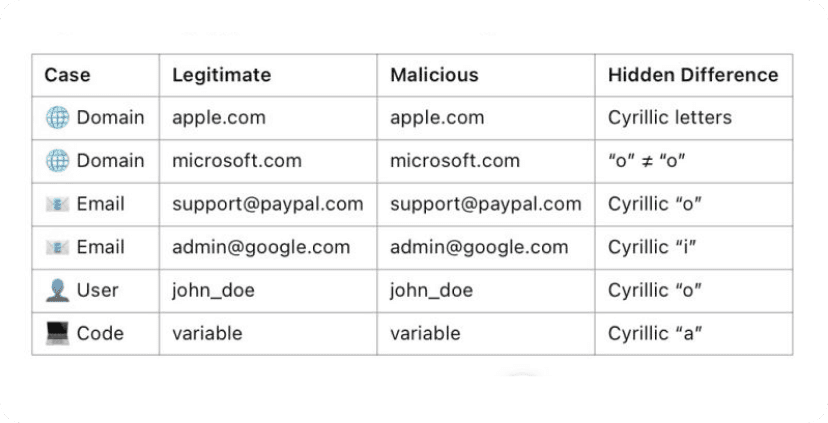
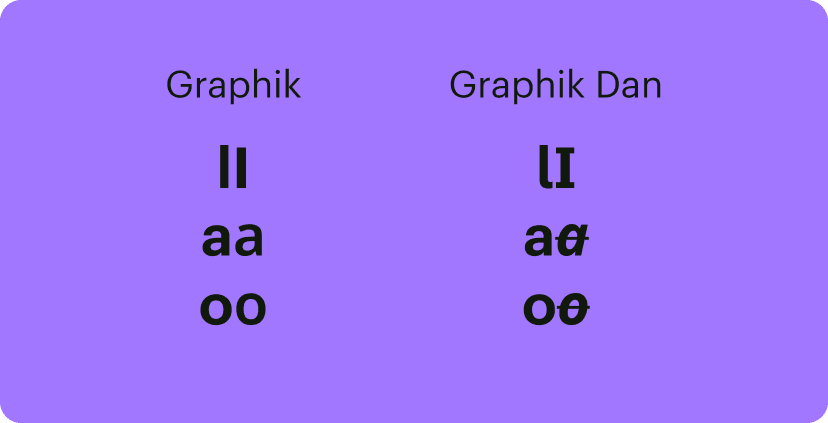
Type that protects — Every category has its scam vector. Domains have theirs — homoglyphs. Cyrillic а and Latin a are indistinguishable in most fonts, so scammers register lookalikes to catch buyers: apple.com becomes аррӏе.com, one click and the wrong name is bought. A custom typeface — Graphik Dan, commissioned with Commercial Type — closed the door.
It also solved a scale problem: tens of thousands of parked pages rendered the brand font, and licensing a public typeface would have been a lawsuit.

Applications
The system extended across every surface the entrepreneur might land on — tens of thousands of parked-domain sale pages, out-of-home billboards, apparel, social, motion. Every touchpoint carrying the same claim.
Activities
Creative direction
Logo and brand system
Typography direction
Website Design
Applications (OOH, motion, social, apparel)
Pitch Deck
Brand Guidelines



The platform rebuild –
for domain investors
Domain investors are the supply side of the marketplace — no investors listing, no marketplace to run. Dan.com had one thing investors respected: transfer speed. Everything else was worse than a Google Sheet, so investors used the platform as a one-way checkout, not a workspace. That meant slow responses to buyers, stale pricing, and no reason to list more inventory here.
The findings that mattered
From month two, investor research ran continuously — broker interviews and in-depth conversations with the professional community. Three findings shaped what got built.
Scale is the whole game. Investors own 51 to 1,000+ domains each — anything that isn't a bulk action is broken at scale.
The workflow isn't uploading — it's managing. Expiry, renewal, registrar, per-domain leads and pricing across a portfolio in the thousands. Hard in Excel, catastrophic to miss.
Response time is a competitive weapon. Domain buyers behave like webshop buyers — they want an answer now. An investor away from a desk was a lead lost.

A workspace built for bulk
The workspace was rebuilt for scale — list view, bulk actions, filters across every dimension (length, views, extensions, leads, pricing, templates), sticky search, filtered exports, DNS management. Every feature had to pass one test on the way in: does this generate revenue or make the platform more self-service? If neither, it needed a strong reason.
Domain buyers expect webshop-instant response. Dan.com transferred a domain in 24 hours; the competition took a week — GoDaddy's own flow could accidentally lock a domain out for seven days. Mobile got a full responsive rebuild so investors could respond from anywhere.
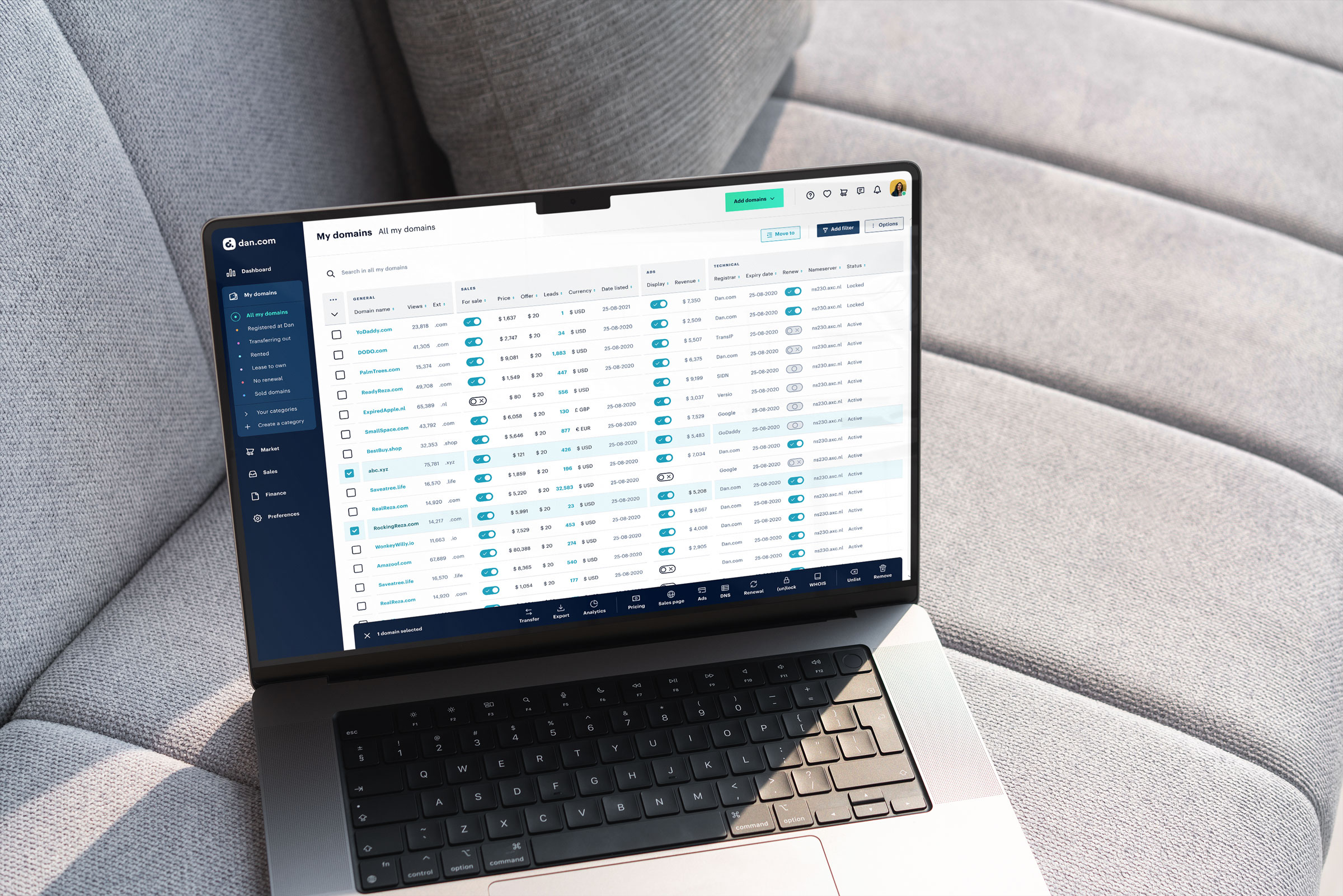


The killer detail: the pricing modal got a math-formula field. Type +10% or -10 straight into a price and the whole catalogue updated. For a professional investor managing 4,000 domains, it's the difference between using the platform and not.
GMV doubled inside the year — €20M to $43M — and domain inventory grew 4.7× as investors moved portfolios onto a platform they could finally work in.

Houston, we shipped
Every major release shipped with a community video walkthrough — tested with a small group first, then out to the investor community. That loop is what kept investors defending Dan.com on forums while we were still shipping — the same defense that outlasted the acquisition and turned into a Reddit obituary two years later.
Activities
Product strategy
Product design
Design system
Flow architecture
Two parallel rebuilds turned Dan.com from a stopgap into a marketplace GoDaddy priced as a strategic buy. The brand gave buyers a reason to trust the first click. The workspace gave investors a reason to spend their day inside it. I helped shape the acquisition pitches to GoDaddy and InternetX/Sedo — and by 2022, the deal closed at $71.4M.
4.7
Trustpilot rating
(up from 4.5)
4.7x
Domains growth
(1.7M → 8M+)
2x
Annual GMV increase
(€20M → $43M)
$71.4M
The team kept shipping the roadmap. Portfolio V2 — the fully revamped bulk-management workspace I'd scoped — launched in the release after I moved on. Seven more product updates followed over the two years that came after.
Previous
Next case